- Python 100%
| Filename | Latest commit message | Latest commit date |
|---|---|---|
| .github/workflows | ||
| docs | ||
| peakweather | ||
| test | ||
| .gitignore | ||
| .readthedocs.yaml | ||
| AUTHORS | ||
| example.py | ||
| LICENSE | ||
| pyproject.toml | ||
| README.md | ||


PeakWeather
MeteoSwiss Weather Station Measurements for Spatiotemporal Deep Learning.



📚 Documentation — 💻 Demo notebook — 🤗 Data — 📄 Paper
PeakWeather is a high-resolution, benchmark-ready dataset for spatiotemporal weather modeling. This repository provides the Python library to load and preprocess the dataset. For full documentation, visit peakweather.readthedocs.io.
Key Features
- High-resolution observations — 10-minute interval data spanning 2017–2025 over 302 SwissMetNet stations across Switzerland
- Multiple variables — Temperature, pressure, humidity, wind, radiation, precipitation and more
- Topographic descriptors — Elevation, slope, aspect, and surface roughness to describe the Swiss complex terrain
- NWP baselines — Ensemble forecasts from ICON-CH1-EPS, the state-of-the-art numerical prediction model operational at MeteoSwiss
- Ideal for — Time series forecasting, missing data imputation, virtual sensing, graph structure learning, and more
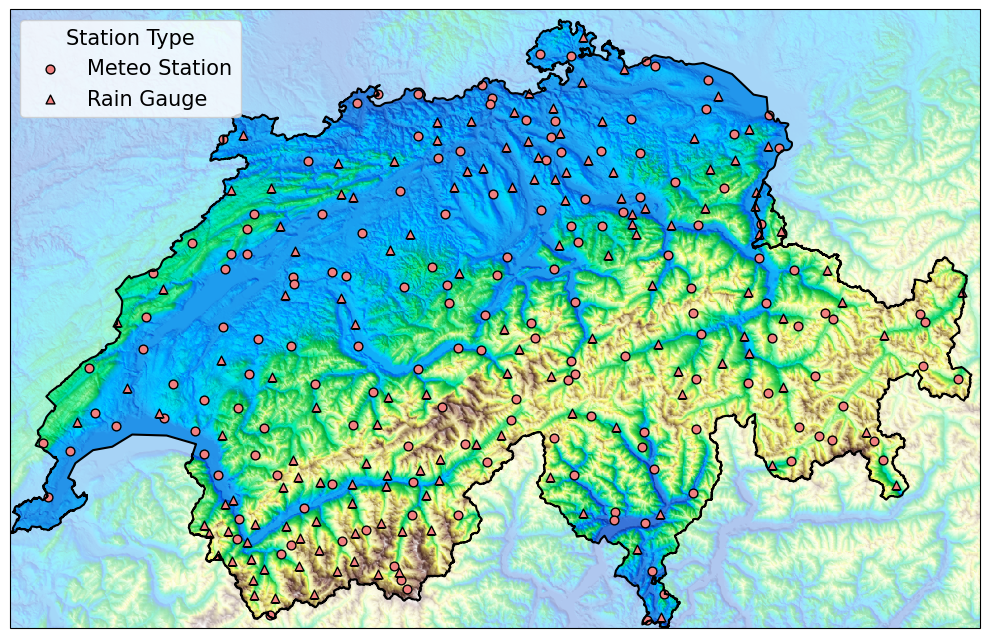
The dataset is hosted on Hugging Face and introduced in the paper:
PeakWeather: MeteoSwiss Weather Station Measurements for Spatiotemporal Deep Learning
Daniele Zambon, Michele Cattaneo, Ivan Marisca, Jonas Bhend, Daniele Nerini, Cesare Alippi. Preprint 2025.
Quickstart
Install
Install PeakWeather from PyPI:
pip install peakweather
This installs the base package with support for station measurements. To also access the topographical descriptors and the NWP data, install the extra dependencies:
pip install peakweather[extended]
Alternatively, install directly from GitHub to stay up to date with the latest developments:
pip install git+https://github.com/MeteoSwiss/PeakWeather.git
pip install "peakweather[extended] @ git+https://github.com/MeteoSwiss/PeakWeather"  # With extras
Load the dataset
On first use, data is automatically downloaded from Hugging Face:
from peakweather.dataset import PeakWeatherDataset

ds = PeakWeatherDataset(root=None)            # Download to the current directory
ds = PeakWeatherDataset(root="path/to/data")  # Or to the specified path
If data is already present at the given path, it is loaded directly.
Get observations
# Single station, all parameters
ds.get_observations(stations='KLO')
# Multiple stations, specific parameters
ds.get_observations(stations=['KLO', 'GRO'], parameters=['pressure', 'temperature'])
| datetime | ('KLO', 'pressure') | ('KLO', 'temperature') |
|---|---|---|
| 2017-01-01 00:00:00+00:00 | 977.8 | -3.3 |
| 2017-01-01 00:10:00+00:00 | 977.7 | -3.5 |
| 2017-01-01 00:20:00+00:00 | 977.6 | -3.5 |
| ... | ... | ... |
For detailed usage, see the full documentation, the provided example, and the demo notebook.
Citation
If you use PeakWeather in your research, please cite:
@misc{zambon2025peakweather,
  title={PeakWeather: MeteoSwiss Weather Station Measurements for Spatiotemporal Deep Learning},
  author={Zambon, Daniele and Cattaneo, Michele and Marisca, Ivan and Bhend, Jonas and Nerini, Daniele and Alippi, Cesare},
  year={2025},
  eprint={2506.13652},
  archivePrefix={arXiv},
  primaryClass={cs.LG},
  url={https://arxiv.org/abs/2506.13652},
}